


Building a Legacy Beyond the Balance Sheet: Why Christian Business Owners Must Plan Their Exit
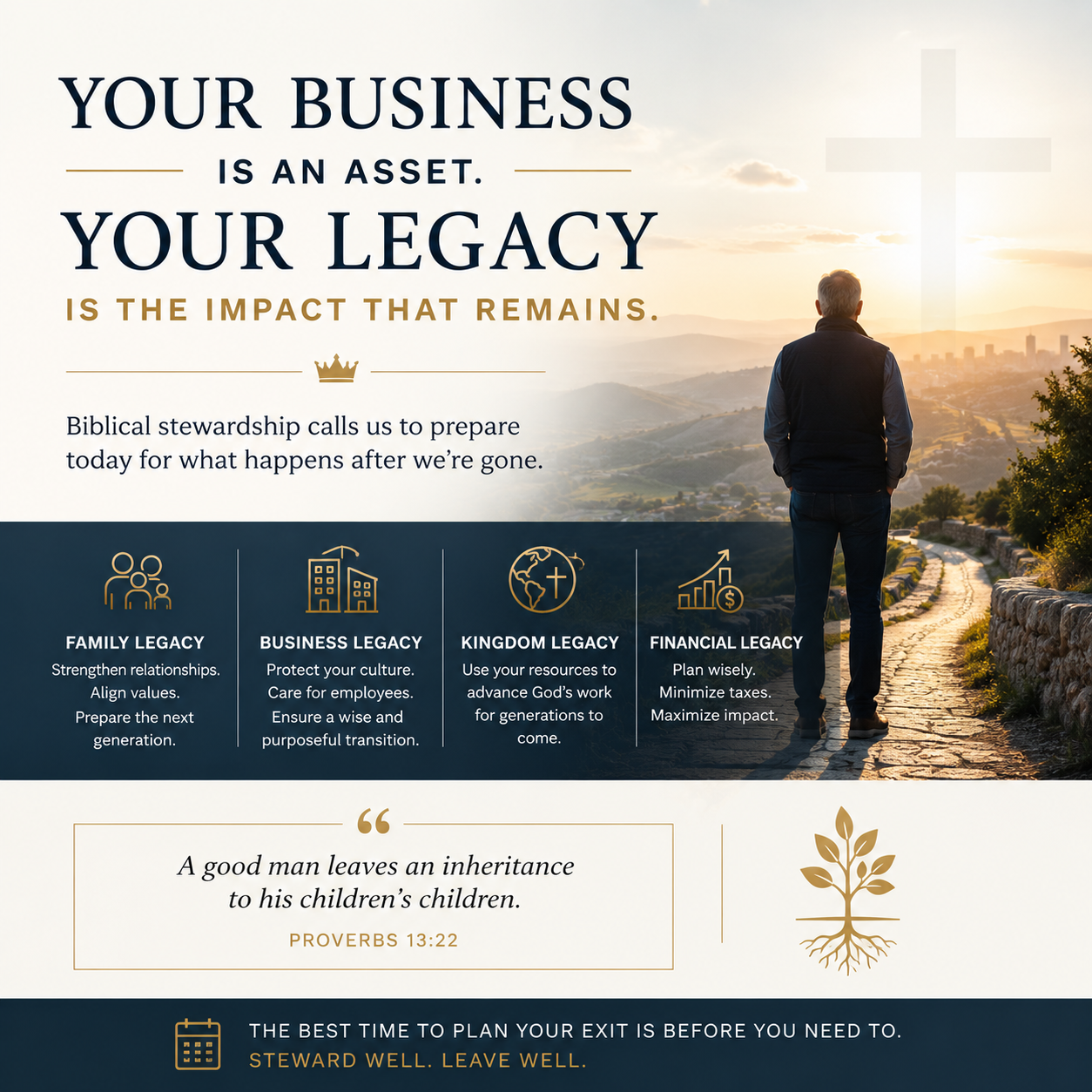
The Business You Built Is Not the Legacy You Leave
Many owners mistakenly equate their business with their legacy.
In reality, a business is a tool. Legacy is the impact that continues after you are gone.
Throughout Scripture, we see examples of faithful stewardship that extended beyond a single lifetime. God consistently calls His people to think generationally rather than merely transactionally.
A business can create tremendous wealth. But wealth without purpose can dissipate within a generation. Conversely, a thoughtfully planned transition can create lasting influence for children, grandchildren, employees, churches, ministries, and charitable causes.
The ultimate measure of success is not simply what you accumulated, but what was entrusted to others through your stewardship.
Why Christian Owners Often Delay Exit Planning
Many business owners understand the importance of planning but postpone it for years.
Common reasons include:
- "I'm not ready to retire."
- "My children haven't decided whether they want the business."
- "The market isn't ideal right now."
- "I still enjoy running the company."
- "I'll deal with it later."
Unfortunately, later often arrives unexpectedly.
Health challenges, economic downturns, partner disputes, disability, or death can instantly force a transition. Businesses that lack a clear succession or exit strategy frequently experience diminished value, family conflict, employee uncertainty, and unnecessary tax burdens.
Good stewardship prepares before a crisis emerges.
Biblical Stewardship Includes Preparing for Transition
Jesus frequently taught about faithful stewardship.
In the Parable of the Talents, the servants were evaluated not simply for possessing resources, but for how they managed them.
Business ownership is no different.
An exit strategy is not merely a financial exercise. It is an act of stewardship that answers important questions:
- How will employees be cared for?
- Will family relationships be strengthened or strained?
- How can charitable goals be advanced?
- How can taxes be managed wisely?
- What values will continue after ownership changes?
The biblical principle is simple: faithful stewards prepare for the future rather than assuming the future will take care of itself.
The Four Dimensions of Legacy Planning
Many owners focus exclusively on maximizing valuation. While important, biblical legacy planning involves four interconnected dimensions.
1. Family Legacy
Significant wealth can either unite or divide future generations.
Owners should consider:
- Family governance structures
- Wealth education for heirs
- Succession expectations
- Fair versus equal inheritance decisions
- Long-term family mission and values
The goal is not merely transferring assets but transferring wisdom.
2. Business Legacy
What happens to the culture and mission of the company?
Questions worth considering include:
- Should the business remain family-owned?
- Would employees benefit from an internal transition?
- Is a strategic buyer the best steward of the company's future?
- How can key employees be rewarded for helping build the enterprise?
The highest purchase price is not always the best outcome.
3. Kingdom Legacy
Many Christian business owners desire their wealth to continue advancing God's work long after they are gone.
This may include:
- Charitable trusts
- Donor-advised funds
- Family foundations
- Church endowments
- Missionary support
- Christian education initiatives
An exit event often creates one of the largest opportunities for Kingdom impact during an owner's lifetime.
4. Financial Legacy
Tax-efficient planning can dramatically increase the amount ultimately available for family and ministry purposes.
Without proper preparation, substantial portions of business value may be lost through avoidable taxation and poor transaction structuring.
Early planning often creates significantly more flexibility and options.
The Best Time to Plan Is Before You Need To
One of the most costly misconceptions among business owners is believing exit planning begins when they are ready to sell.
In reality, the most successful exits are often planned three to ten years in advance.
Advance planning can help:
- Increase enterprise value
- Reduce business risk
- Strengthen management teams
- Improve buyer attractiveness
- Optimize tax outcomes
- Clarify family expectations
- Align wealth with Kingdom objectives
The earlier planning begins, the greater the number of available options.
A Different Question for Christian Owners
Most exit planning conversations begin with:
"How much is my business worth?"
While important, Christian business owners should start with a different question:
"What has God entrusted to me, and how can I steward it faithfully for future generations?"
That shift changes everything.
It transforms exit planning from a financial event into a legacy strategy.
It moves the focus from accumulation to impact.
And it helps ensure that the blessings generated through years of faithful work continue serving purposes that extend far beyond a single lifetime.
Final Thoughts
Every business owner will eventually leave the company they built.
The true test of stewardship is not whether the transition occurs, but whether it reflects intentional planning, biblical wisdom, and a commitment to generational impact.
Your business may be one of God's greatest financial blessings in your life.
The question is whether the value you've created will simply be transferred—or whether it will become a lasting legacy that advances your family, your community, and God's Kingdom for generations to come.
Call to Action:
If you are a Christian business owner with significant business value, now is the time to begin thinking about succession, stewardship, and legacy planning. The most effective strategies are developed years before a transition occurs—not months before closing a deal.